What is direct cremation?
Direct cremation is a simple cremation without a public funeral service beforehand.
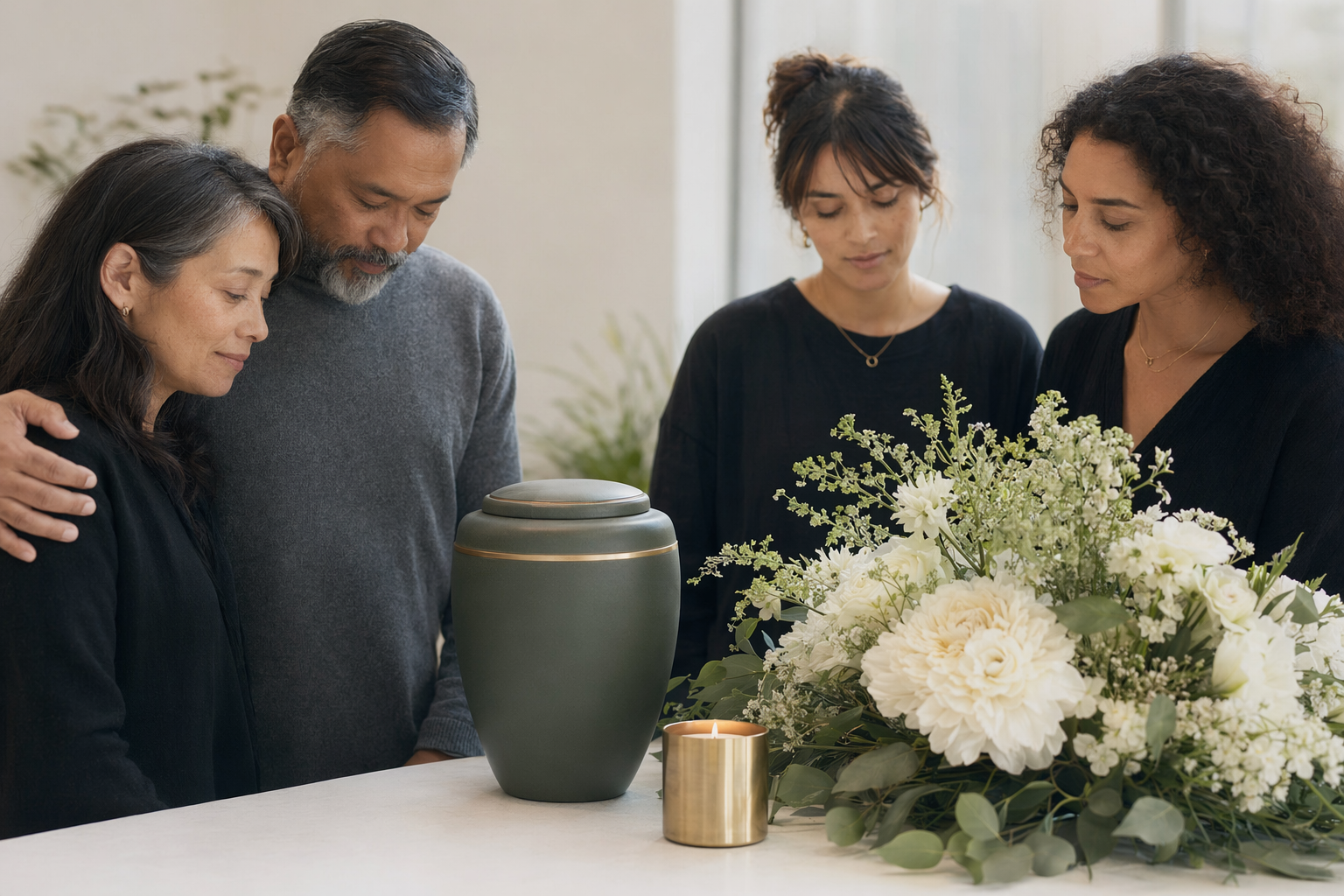
For many families, direct cremation is a lower-cost, simpler option when someone dies. It can also give people more time to plan a memorial later, in their own way.
Stillpoint is a free matching service. We are not a funeral home or crematory, and we do not arrange funerals or perform cremations. We share general educational information so you can compare licensed providers and ask clear questions.
In plain language
Direct cremation usually means the person is cremated soon after death, without viewing, visitation, or a funeral service first. A family can still hold a memorial later, with or without ashes present.
Plain-language overview
Direct cremation is one of the simplest funeral choices. In most cases, the funeral home or cremation provider brings the person into its care, files the needed paperwork, gets the permits, places the person in a simple container, and arranges the cremation. The ashes are then returned to the family in a basic container or urn.
What it usually does not include is a viewing, visitation, embalming, hearse procession, formal ceremony at the funeral home, or cemetery burial costs. Families who choose direct cremation often plan a memorial, celebration of life, or private gathering later. You can read more about cremation and memorials and celebrations of life if that would help.
Direct cremation can be arranged after a death, or discussed ahead of time as part of pre-planning.
- Simple cremation without a public service first
- Usually lower cost than full-service funeral options
- Memorial can still happen later, in any setting that feels right
What to know before you choose
Direct cremation can be a good fit for families who want simplicity, lower costs, less formality, or more time before gathering people together. It may also suit someone who did not want a traditional funeral.
Even so, simple does not mean careless. You still have choices, and it is okay to ask slow, clear questions.
Important things to confirm:
- Whether the provider is licensed in your state
- Exactly what the price includes and does not include
- Whether transportation is included, and from how far away
- Whether the cost includes permits, filing paperwork, and the death certificate fee or only some of those items
- Whether the ashes are returned in a temporary container or an urn
- How long the process usually takes
- Whether there are extra charges for weight, refrigeration, pacemaker removal, or delivery of ashes
Families also have important rights under the FTC Funeral Rule. You can ask any funeral home for an itemized General Price List before you buy. You have the right to buy only the goods and services you want. You can usually buy an urn elsewhere. You can also decline embalming where it is not legally required. Embalming is rarely required by law.
Prices shown online are often starting points, not full totals. Ask for the full price in writing and ask for the provider's GPL.
- Ask for an itemized GPL
- Confirm all fees in writing
- Do not feel pressured to buy extras you do not want
Step by step: how direct cremation usually works
The details can vary by state and provider, but the process often looks like this:
- A family member or authorized person contacts a funeral home or cremation provider.
- The provider brings the person into its care.
- The family completes authorization forms and provides information for the death certificate.
- The provider files paperwork and obtains required permits.
- If needed, the provider asks the medical examiner, coroner, or doctor for approval to move forward.
- The person is placed in a cremation container. This is usually a simple alternative container, not an expensive casket.
- The cremation takes place.
- The ashes are placed in a temporary container or chosen urn and returned to the family, or sent where state law allows.
If the family wants one, a memorial can happen days or weeks later. Some families hold a small gathering at home. Others use a place of worship, park, restaurant room, or community space. Some keep it very private.
If you are arranging care after a recent death, at-need arrangements may help explain the next steps.
- Timing depends on paperwork and local rules
- A simple container is usually included
- A later memorial is common
Costs and choices
Direct cremation is often one of the least expensive professional funeral options, but the total can still vary a great deal by city, state, and provider. A typical range is often about $800 to $3,500, though some areas may be lower or higher. This is a typical range, not a quote.
The lowest advertised price may include only the basic direct cremation service. Other necessary or optional charges can change the total.
Common cost items to ask about:
- Transfer of the person into the provider's care
- Basic services of the funeral home or cremation provider
- Refrigeration or sheltering
- Paperwork and permit filing
- Cremation fee
- Alternative container
- Temporary container for ashes
- Death certificates
- Medical examiner or coroner fees, where applicable
- Extra mileage or service area charges
- Optional urns, memorial items, or witness cremation fees
You are allowed to keep the arrangement simple. You do not have to buy a package with items you do not want. You may also be able to buy an urn somewhere else.
If cost is a main concern, compare several licensed providers. Ask each one for its GPL and a written breakdown of the full expected total. Stillpoint can help you get matched, at no cost, with licensed funeral homes and cremation providers near you so you can compare options calmly.
- Typical direct cremation range: about $800 to $3,500
- Ask what is included before you agree
- Confirm whether death certificates are included or separate
Who it may suit, and when to pause
Direct cremation may suit:
- Families who want the simplest arrangement
- People with a limited budget
- Someone who did not want viewing or a formal funeral
- Families spread across different places who want to gather later
- People planning a personal memorial outside the funeral home
It may be worth slowing down if:
- Family members strongly disagree about having time to say goodbye
- Your faith or culture has customs that need to happen first
- You want a viewing or visitation before cremation
- You are unsure who has legal authority to make decisions
Some people worry that choosing direct cremation means there can be no ceremony or no dignity. That is not true. A simple cremation can still be handled with care and respect. The memorial can be as small or as meaningful as you want.
If you are planning ahead, remember that pre-need funeral contracts and final-expense insurance are different. Ask how each works, whether your money is protected, and what happens if you move or change your mind. Insurance involves a licensed agent. Stillpoint does not sell pre-need contracts or insurance.
- Simple does not mean impersonal
- A later ceremony is still possible
- Planning ahead and paying ahead are not the same thing
How Stillpoint can help
When someone dies, or when you are planning ahead, it can be hard to know which questions to ask. Stillpoint helps families understand their choices and get connected, for free, with licensed funeral homes and cremation providers nearby.
We are not a funeral home, crematory, cemetery, funeral director, or insurance seller. We do not perform cremations or sell merchandise. Our role is to help you compare options and ask informed questions.
If you want, you can learn how it works or get matched with providers near you. When you speak with any provider, ask for the GPL, confirm licensing in your state, and request all prices in writing before you decide.
- Free matching with licensed providers
- Educational help, not legal or insurance advice
- Compare written prices and services side by side
Always use a licensed funeral home or cremation provider, and confirm every price in writing before you agree.